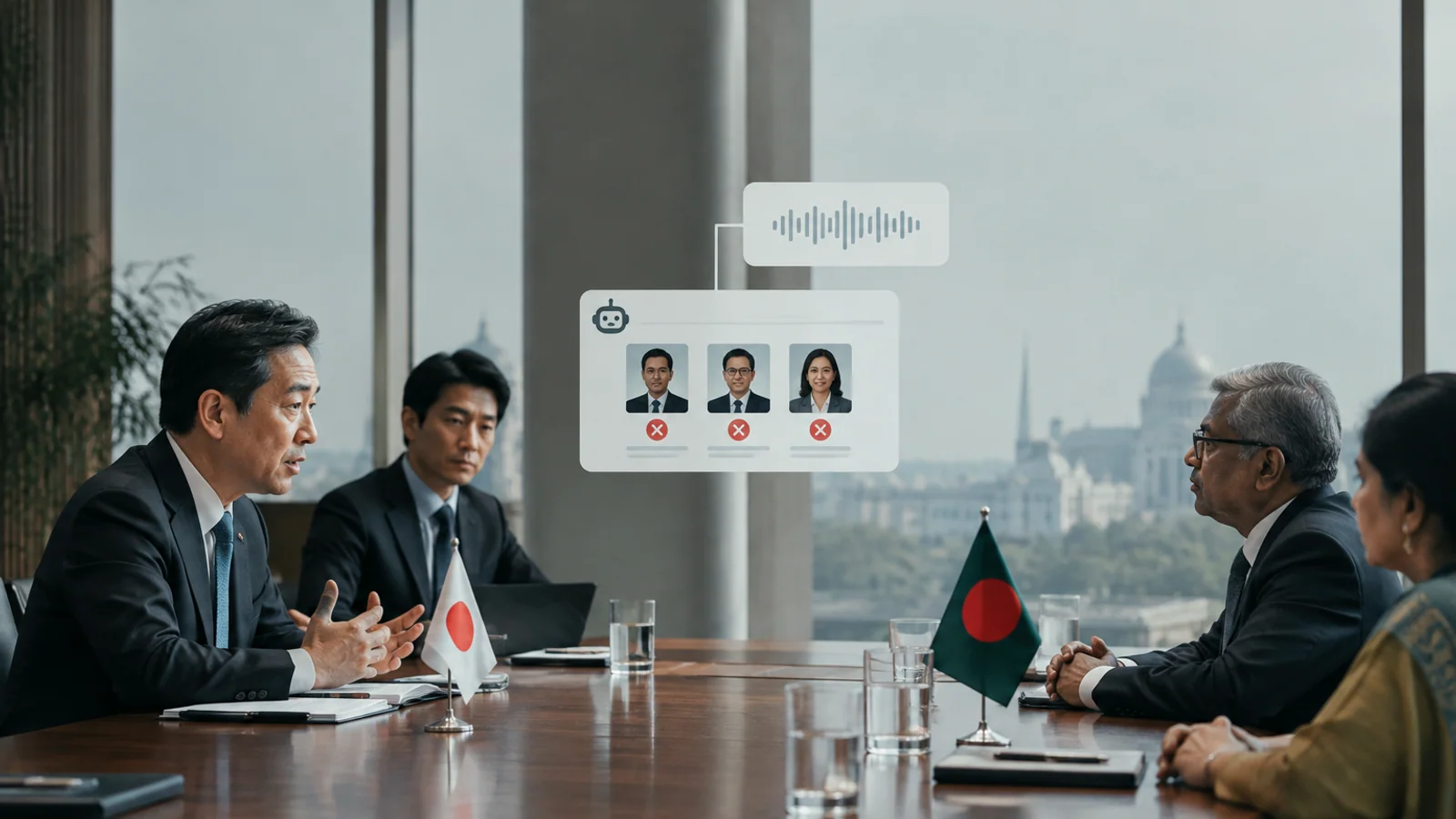
AI translation errors in professional communication occur when general-purpose models prioritize linguistic fluency over factual precision. In high-stakes environments, these errors can lead to diplomatic friction or legal liabilities. To prevent them, organizations require specialized multilingual voice infrastructure that integrates expert-led data and native audio processing rather than relying on generic large language models (LLMs) that lack contextual awareness.
The Incident: When AI Redrafts Diplomacy
The inherent risks of using commodity AI for professional translation were recently highlighted by a high-profile incident involving the Japanese government. Japanese Minister Ryosei Akazawa publicly addressed errors made by X’s Grok AI, which incorrectly translated and replaced the names of three senior officials during a meeting with the new prime minister of Bangladesh. According to reporting from Slator, these errors were significant enough to be labeled a diplomatic blunder.
This is not a localized software glitch but a symptom of how general-purpose generative AI functions. These models are designed to predict the most likely next word in a sequence based on vast datasets scraped from the internet. In a diplomatic or enterprise setting, where titles, honorifics, and specific nomenclature carry immense weight, the "probability-based" nature of commodity AI becomes a liability. When an AI prioritizes sounding natural over being accurate, it enters the realm of hallucination—inventing facts to maintain a smooth sentence structure.
Why General-Purpose AI Hallucinates in Translation
To understand why AI translation errors in professional communication are so persistent, one must look at the underlying architecture of most consumer tools. Most translation services currently rely on a "cascaded" approach: they convert speech to text, translate the text using an LLM, and then convert it back to speech.
Every step in this chain introduces a point of failure. The LLM, which serves as the middle layer, often lacks the "ground truth" required for specialized industries. It may understand the grammar of Japanese and English, but it does not necessarily know the current administrative roster of the Japanese Ministry or the specific nuances of a corporate merger. Without a dedicated infrastructure that prioritizes factual verification, the system is essentially guessing.
This gap in quality has led to a significant shift in how AI is being trained for the enterprise. There is an increasing demand for expert-led AI data work, as companies realize that raw web-scraped data is insufficient for high-stakes accuracy. Professional communication requires data curated by linguists and subject matter experts to ensure that the AI understands context, not just syntax.
Moving from Tools to Infrastructure
The Japanese Ministry incident validates the argument that translation should not be treated as a casual "add-on" or a side feature of a social media platform or a general-purpose chat bot. Instead, it must be treated as a core component of an organization's communication infrastructure.
Hitoo's approach is designed to address this by moving away from "black box" commodity translators. Hitoo is being developed as a multilingual speech layer that integrates into existing workflows. Rather than forcing a conversation into a specific translation app, the goal is to provide a native layer that processes audio in real time with high fidelity.
Hitoo Desktop, currently under development for macOS and Windows, is designed to connect microphones, speakers, and live communication software directly to this specialized layer. The architecture is intended to allow organizations to preserve their existing workflows—whether they use Teams, Zoom, or proprietary SIP environments—while adding a level of linguistic precision that generic tools cannot guarantee. This focus on infrastructure allows for better latency management, privacy-conscious operational logging, and the implementation of enterprise-wide policies.
AURIS and the Future of Voice Fidelity
While current systems often struggle with the limitations of cascaded architectures, the industry is moving toward more direct methods. Hitoo’s proprietary research initiative, AURIS, is investigating direct speech-to-speech translation.
Traditional models lose the speaker’s tone, intent, and identity during the transcription-translation-synthesis process. AURIS research targets a direct architecture that maps audio from one language to audio in another. The research objective is to preserve the speaker's voice identity and emotional nuance while significantly reducing the architectural complexity that leads to hallucinations. Research targets for AURIS include end-to-end latency below 400 ms and support for over 1,100 direct translation paths, aiming to make multilingual conversations feel as natural as unmediated ones.
The Enterprise Requirement for Accuracy
For a global organization, a single translation error can mean the difference between a successful contract and a legal dispute. When names are swapped, or technical terms are misinterpreted, the cost of using a free or commodity tool far outweighs the initial convenience.
Enterprise-grade communication requires a managed approach. Hitoo Enterprise is being designed to offer organizations centralized control over their multilingual communication. This includes managed deployment, role-based administration, and data sovereignty requirements—ensuring that sensitive diplomatic or corporate data is not merely fed back into a general-purpose model's training set.
As AI continues to integrate into every facet of global business, the distinction between "good enough" for social media and "accurate enough" for the boardroom will become the defining factor in technology adoption. Specialized multilingual voice infrastructure is no longer a luxury for international organizations; it is a necessity for maintaining professional integrity in a connected world.
Put it into practice
Three steps to apply these ideas to your context.
Choose a recurring conversation and define who needs to understand whom, the topic and the expected outcome.
Document the languages, participants, tools and test limitations so that results remain comparable and repeatable.
Collect errors, requests for clarification and participant feedback, then compare them with your starting point.
The next step
Explore use cases