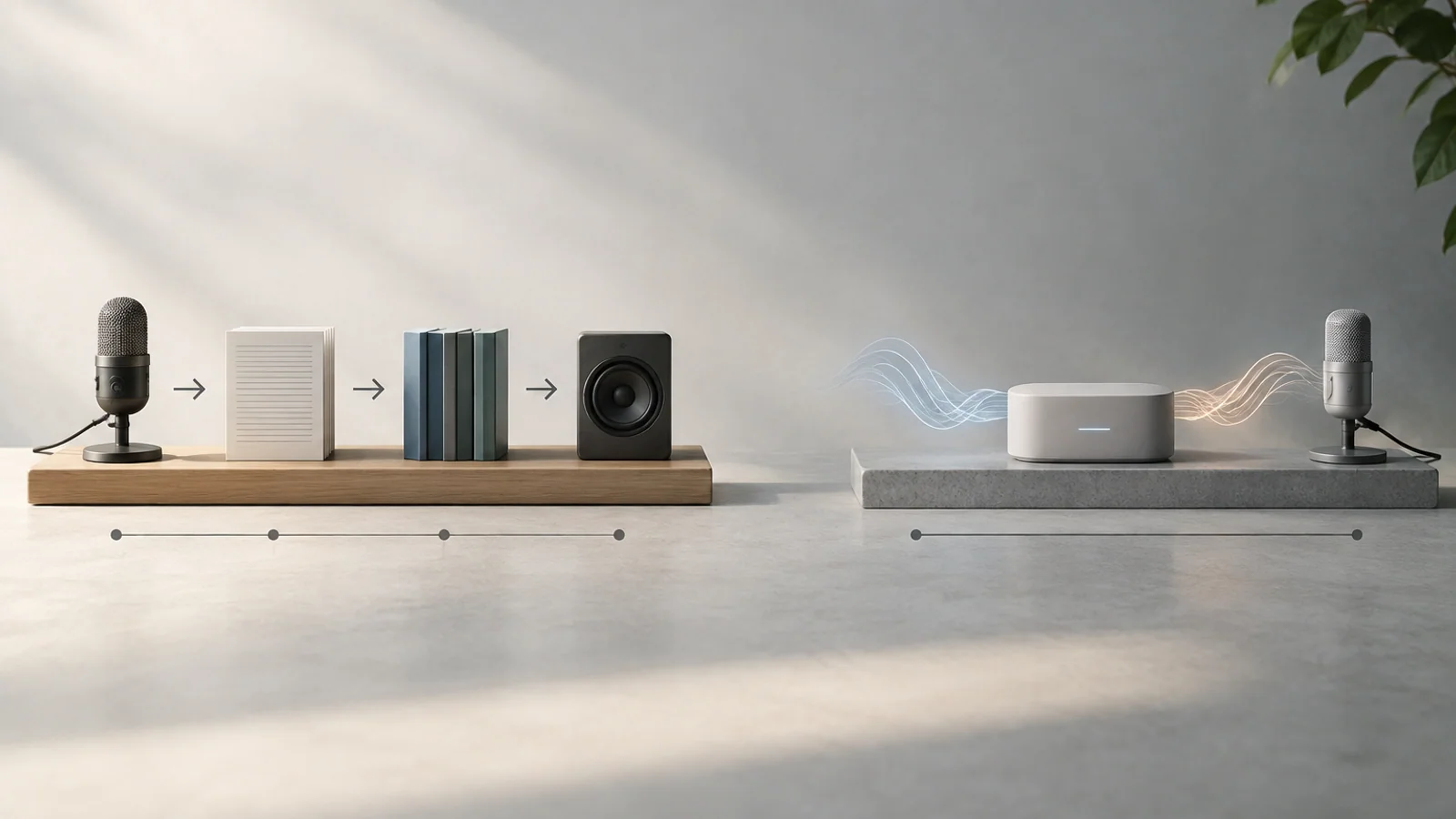
Recent advancements in direct speech-to-speech translation (S2S) are fundamentally changing the requirements for enterprise multilingual communication. By eliminating the multi-step process of converting audio to text and back again, direct S2S models significantly reduce latency and preserve the speaker's original voice identity. This shift necessitates a move away from isolated translation bots toward a dedicated multilingual voice infrastructure that integrates seamlessly with existing professional workflows and communication platforms.
The Technical Evolution of Speech Translation
For years, multilingual digital communication relied on a cascaded architecture. In this traditional model, a system first performs Automatic Speech Recognition (ASR) to turn audio into text, then applies Machine Translation (MT) to change the language, and finally uses Text-to-Speech (TTS) synthesis to generate new audio. While functional, this approach is inherently flawed for natural conversation. Each step in the cascade introduces its own delay, and errors often compound as they move through the pipeline. More importantly, the human element—the tone, emotion, and unique vocal characteristics of the speaker—is typically lost in the transition to text.
Direct speech-to-speech translation represents a paradigm shift. Rather than relying on an intermediate text layer, these emerging architectures are designed to map audio signals in one language directly to audio signals in another. This end-to-end approach is the focus of intense industry development, as it promises to bring conversational latency down to levels that mirror human interaction while maintaining the nuanced prosody of the original speaker.
Market Signals and Industry Consolidation
The move toward direct architectures is no longer theoretical; it is being driven by significant investment and strategic acquisitions. ElevenLabs recently acquired the Japanese voice AI startup Kotoba in a deal valued at over $100 million, specifically to bolster its capabilities in speech-to-speech translation. This acquisition highlights the growing importance of models that can handle multilingual voice processing as a single, unified task rather than a series of disconnected steps.
Parallel to these developments, major platform providers are updating their live communication suites to incorporate more sophisticated voice agents. At Ignite 2026, Microsoft announced updates regarding its live speech translation and synthetic voice capabilities, signaling that real-time multilingual support is becoming a core requirement for enterprise productivity tools. These shifts indicate that the era of the "translation bot"—a clunky third-party participant in a meeting—is ending. In its place, organizations are looking for a native speech layer that exists within their current infrastructure.
Why Identity and Latency Matter in Enterprise
In a professional context, communication is about more than just the literal meaning of words. In sales, negotiation, and leadership, the way something is said is often as important as what is said. Cascaded models, by stripping voice down to text, remove the authority, warmth, or urgency from a speaker's voice. Direct S2S translation aims to solve this by preserving voice identity across language barriers. When a CEO speaks to a global team, the infrastructure should allow them to sound like themselves, regardless of the language the listener hears.
Latency is the other critical factor. Natural human conversation typically has gaps of less than 250 milliseconds between speakers. Traditional cascaded systems often introduce several seconds of delay, which disrupts the flow of dialogue, leads to participants talking over one another, and causes cognitive fatigue. Direct models are being developed to target much lower latency benchmarks, aiming for a near-instantaneous experience that allows for true full-duplex communication where interruptions and overlapping speech are handled naturally.
The Role of Multilingual Voice Infrastructure
As these powerful S2S models emerge, the challenge for the enterprise becomes one of deployment. Powerful models are useless if they cannot be accessed within the tools teams already use every day. This is why the focus is shifting toward multilingual voice infrastructure—a layer that connects these advanced models to the actual endpoints where conversation happens.
Building this infrastructure requires solving complex architectural problems. Organizations need bidirectional audio routing that can capture a speaker's voice from a microphone, process it through an S2S model, and deliver the translated audio back to the participants' speakers or headsets. Furthermore, this must happen in a way that respects enterprise requirements for privacy, data sovereignty, and centralized management.
Hitoo is being developed to address this infrastructure gap. Rather than acting as another meeting platform, Hitoo is designed to add a multilingual speech layer to the communication tools companies already use. The Hitoo Desktop runtime, currently under development for macOS and Windows, is intended to manage native audio capture and virtual audio routing, allowing organizations to deploy direct translation capabilities across any environment, from Zoom and Teams to bespoke SIP-based systems.
AURIS and the Future of Direct Communication
Hitoo’s internal research initiative, AURIS, is specifically dedicated to the frontier of direct speech-to-speech translation. The research objective is to move beyond the limitations of cascaded systems by developing a direct architecture that preserves meaning, tone, and voice identity. AURIS targets more than 1,100 direct translation paths with a research goal of achieving end-to-end latency below 400 milliseconds.
This research represents the next stage of human-to-human communication. By focusing on a direct audio-to-audio path, AURIS is designed to eventually support natural, high-stakes conversations where the nuance of the human voice is preserved. While these technologies continue to evolve, the direction is clear: the future of global business depends on a multilingual speech layer that is as invisible and reliable as the internet itself.
Strategic Requirements for Global Organizations
For organizations managing distributed, global workforces, the transition to direct S2S infrastructure is a strategic necessity. Success in this new landscape requires a focus on three areas:
- Workflow Integration: Translation must happen within the existing communication workflow, not as a separate destination or platform.
- Voice Authenticity: Preserving the speaker's identity is essential for maintaining trust and professional presence in cross-border interactions.
- Managed Deployment: Enterprise voice AI requires centralized control, auditability, and adherence to privacy policies.
The Hitoo Enterprise framework is being designed as a managed endpoint infrastructure to provide this level of oversight. The architecture is intended to allow for centralized policy management, device enrollment, and operational telemetry, ensuring that as multilingual voice becomes a standard part of business, it remains secure and manageable at scale. The shift to direct speech-to-speech translation is more than a technical upgrade; it is the foundation for a truly borderless enterprise.
Put it into practice
Three steps to apply these ideas to your context.
Check language directions, audio conditions and benchmark metrics before applying a research finding to your scenario.
Separate published results, research goals and demonstrated features: ask which can be verified in the proposed test.
Have someone who knows both languages check whether numbers, negations, intentions and corrections retain their meaning.
The next step
Explore AURIS research