Why Infrastructure Defines Multilingual Voice Success
Enterprise multilingual voice success shifts from model selection to the serving harness. Learn why infrastructure is the new competitive differentiator.
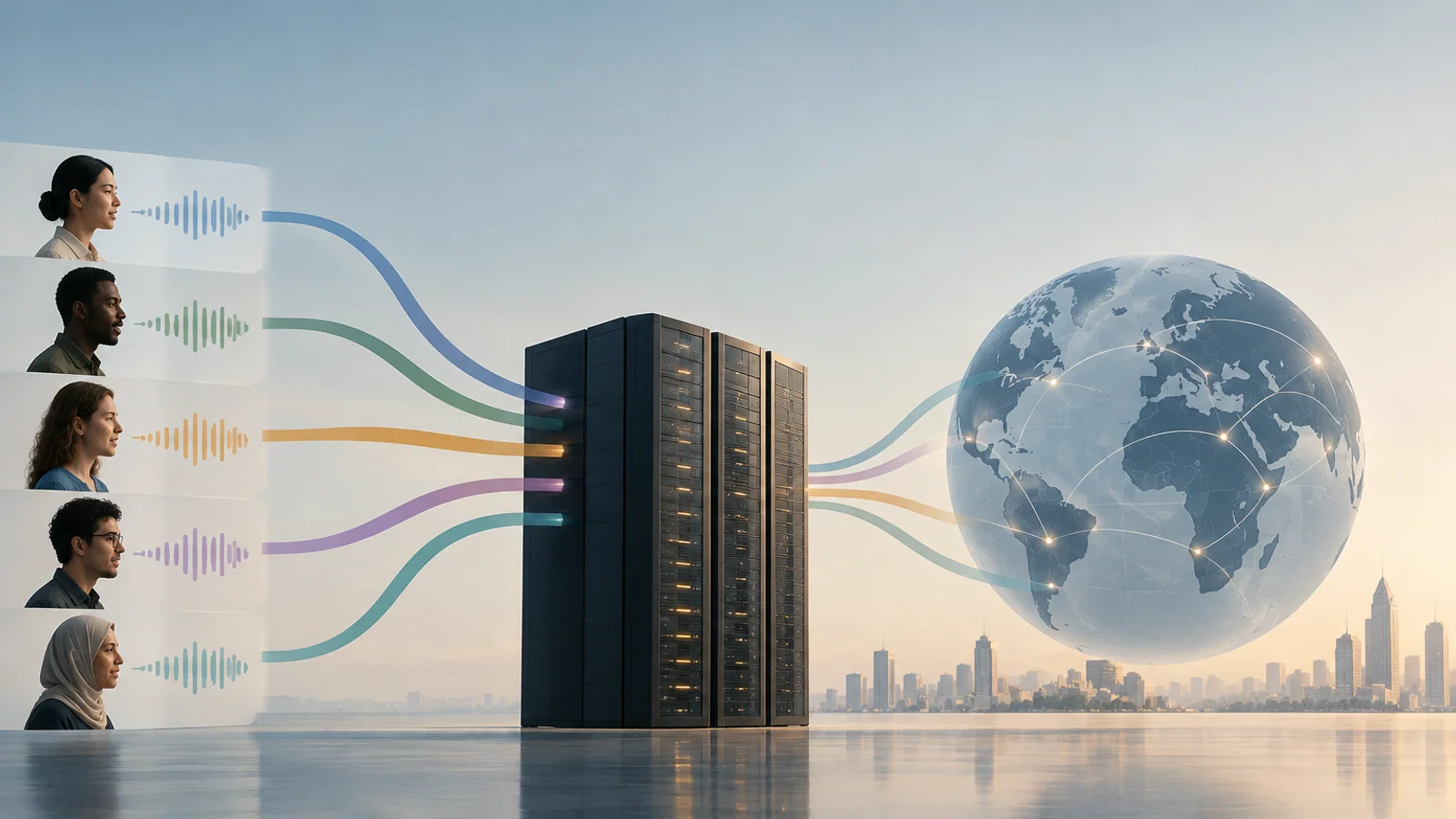
For organizations scaling global operations, the primary challenge of multilingual communication has shifted. While early AI efforts focused on selecting the most capable speech model, the rapid commoditization of these models means the 'what' of AI—the model itself—is no longer the bottleneck. The critical differentiator is now the multilingual voice infrastructure: the specialized serving harness that manages real-time constraints, latency, and bidirectional audio routing within existing corporate workflows.
As speech-to-speech technology matures, the industry is witnessing a fundamental change in architectural priority. Recent developments, such as Mistral’s update to its transcription and generation tools, demonstrate that high-quality multilingual speech capabilities are becoming widely accessible. However, as noted in a recent analysis by MIT Technology Review, the next competitive advantage for enterprise AI lies less in the model and more in the engineering system surrounding it.
The Commodity of the Model
For years, the conversation around AI was dominated by benchmarks and parameter counts. Today, a variety of high-performing multilingual models can transcribe and synthesize speech with remarkable accuracy. While these models are the engines of translation, they are not the complete vehicle. For a business, the model is a commodity; the ability to use that model reliably across thousands of concurrent sessions is the true engineering hurdle.
When a model is integrated into a live conversation, it encounters constraints that do not exist in a laboratory setting. These include unpredictable network jitter, varying hardware endpoints, and the necessity for full-duplex communication where participants can interrupt or overlap with one another. A standalone model cannot solve these issues. It requires a dedicated infrastructure layer to mediate between the audio source and the AI's processing capabilities.
Why the Serving Harness Matters
The concept of a 'serving harness' describes the architecture, memory management, and optimization decisions that determine how a model’s intelligence becomes a production-grade capability. In the context of multilingual voice, this harness must address the unique demands of human conversation. Unlike document processing, where a delay of several seconds is acceptable, voice communication requires sub-second responsiveness to feel natural.
Conversational latency is the sum of many parts: audio capture, packet transmission, transcription, translation, synthesis, and playback. If the infrastructure surrounding the model is inefficient, even the fastest AI will fail to maintain the flow of a meeting. Enterprise leaders are beginning to realize that investing in the system—the multilingual voice infrastructure—is more impactful than chasing the marginal gains of a slightly larger model.
Hitoo as a Multilingual Speech Layer
Hitoo is designed to provide this essential infrastructure for modern communication. Rather than moving conversations to a new, proprietary platform, Hitoo adds a real-time multilingual speech layer to the tools organizations already use. This approach allows employees to continue speaking their own language while preserving their existing communication workflows in environments like Zoom, Teams, or Slack.
The development of Hitoo Desktop focuses on the endpoint runtime required to manage native audio capture and bidirectional routing. This architecture is intended to handle the complexities of live session controls and interruption handling, ensuring that the 'harness' supports the natural cadence of human speech. By focusing on the infrastructure layer, Hitoo allows enterprises to deploy multilingual capabilities that are both reliable and economically scalable.
Solving for Production Constraints
Transitioning from an AI proof-of-concept to full-scale production introduces several architectural pressures:
- Concurrency: Managing hundreds of simultaneous multilingual sessions without degradation in performance.
- Telemetry: Real-time monitoring of latency and audio quality to ensure a consistent user experience.
- Privacy and Governance: Implementing centralized policies and operational logging that satisfy enterprise data sovereignty requirements.
These are infrastructure problems, not model problems. A model optimized for fast responses may still struggle if the serving architecture cannot handle the memory pressure of high concurrency. Hitoo Enterprise is being developed to address these specific organizational needs, providing managed deployment and device enrollment within a secure, administrative framework.
The Evolution Toward Direct Translation
While current systems often rely on a cascaded architecture—linking speech recognition, machine translation, and synthesis—the future of voice infrastructure points toward more direct paths. Hitoo’s AURIS research initiative is exploring direct speech-to-speech translation models. The objective of this research is to reduce architectural complexity and conversational latency by moving away from the multi-step cascade.
By investigating direct translation, AURIS targets the preservation of a speaker’s original tone, expression, and voice identity across languages. This transition from cascaded steps to end-to-end models further emphasizes the need for a robust infrastructure. The more sophisticated the translation method, the more critical the surrounding 'harness' becomes to deliver that intelligence to the end-user without technical friction.
Building for Resilience
The most important reason to prioritize infrastructure over specific models is resilience. The AI landscape moves quickly; a model that leads the market today may be surpassed tomorrow. An organization that builds its strategy around a specific model risks technical debt and vendor lock-in.
In contrast, a strategy built on a modular multilingual speech layer allows an organization to remain agile. As better models or new hardware accelerators become available, the infrastructure can adapt without requiring a complete overhaul of the business workflow. The goal is to build an environment where multilingual intelligence is a reliable, integrated utility, allowing humans to communicate naturally regardless of the underlying technology.
Multilingual voice infrastructure
Real-time voice translation. Zero setup, zero interruptions.
Request a demo