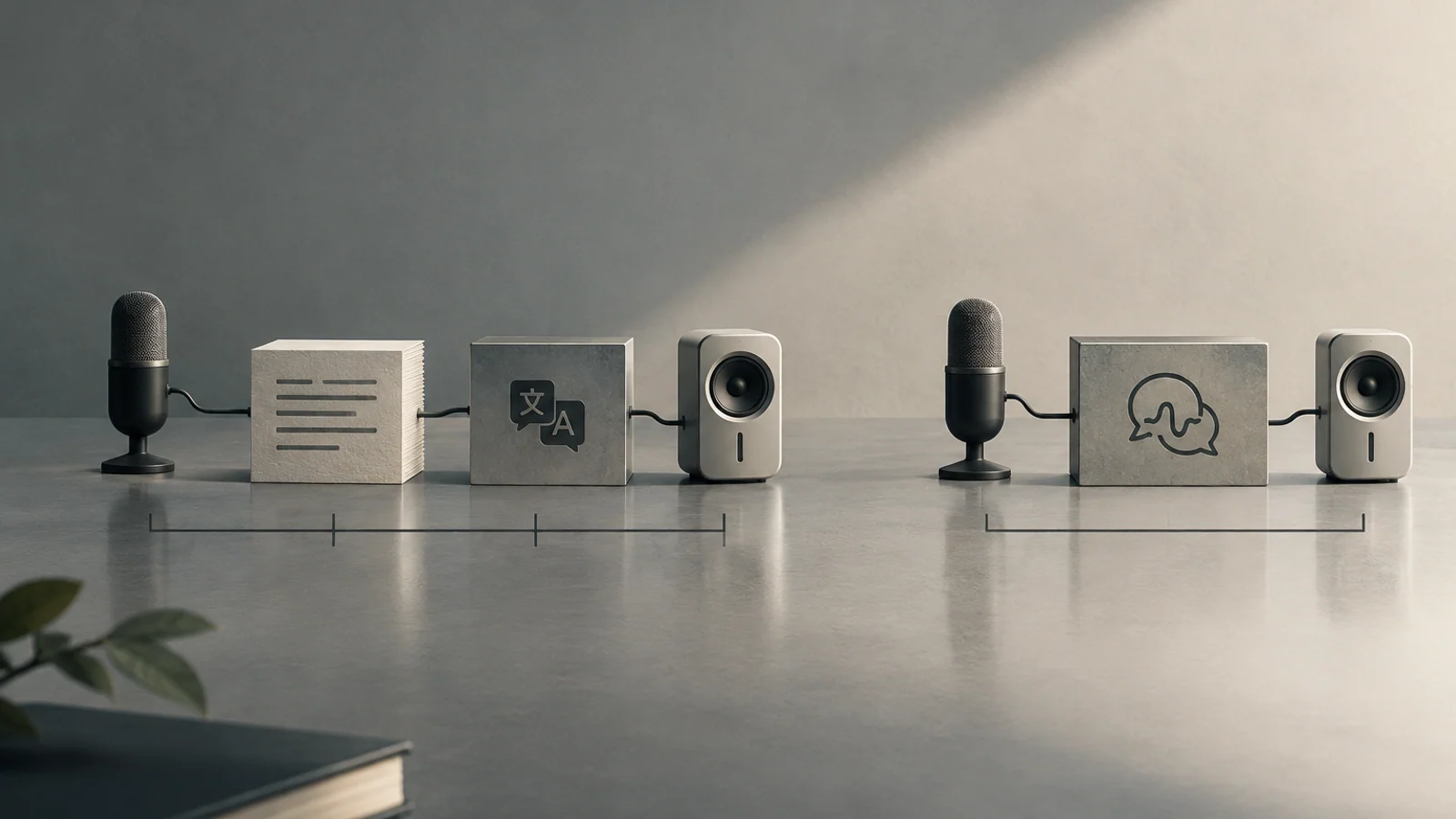
Direct speech-to-speech translation is an emerging architectural approach that converts spoken audio from one language to another without passing through intermediate text representations. While traditional 'pivot' models dominate the current landscape, they often fail the rigorous latency requirements of real-time enterprise communication. For natural, full-duplex conversations, organizations require a direct speech layer that preserves vocal identity and eliminates the cumulative delays inherent in cascaded processing workflows.
The Hidden Cost of Pivot Models
In the current multilingual landscape, most translation workflows rely on a 'pivot' or cascaded architecture. This involves a sequence of discrete steps: Automatic Speech Recognition (ASR) to convert audio to text, Machine Translation (MT) to move from one language to another, and finally Text-to-Speech (TTS) to generate the output audio. While this modularity has served the industry well for asynchronous tasks, it introduces a significant 'latency debt' that is increasingly untenable for live interaction.
Recent research by Julia Fanger on pivot subtitling suggests that indirect translation can achieve quality parity with direct methods in specific contexts like subtitling. However, subtitling is fundamentally a 'snapshot' process where the delay between the spoken word and the appearing text is expected and manageable. In a live voice conversation, that same delay creates cognitive friction. When two people are in a high-stakes negotiation or a technical support call, a two-second delay transforms a fluid exchange into a series of disjointed monologues.
This latency is not merely a technical annoyance; it is a communication barrier. Humans rely on rapid-fire feedback—nods, brief interjections, and immediate responses—to signal understanding. Pivot models, by their nature, force the speaker to wait for the entire 'cascaded' chain to complete before the listener hears the first syllable. This architectural overhead makes true full-duplex communication—where both parties can speak and react simultaneously—nearly impossible.
Shifting Toward Direct Speech-to-Speech Architectures
To overcome these limitations, the industry is moving toward direct speech-to-speech translation (S2ST). In this model, a single neural network is trained to map audio features in the source language directly to audio features in the target language. By bypassing the intermediate text stage, the system reduces the number of processing steps, theoretically lowering the floor for conversational latency.
The push for directness is not limited to software. The frontier of this field even extends into medical and neural research. As reported by MIT Technology Review, scientists are investigating ways to decode brain activity into speech, emphasizing a shift toward high-fidelity, immediate output. While neural implants represent the extreme edge of this technology, the underlying principle is the same: the more direct the path between thought (or speech) and expression, the more natural the communication becomes.
At Hitoo, the AURIS research initiative is specifically designed to explore this direct S2ST frontier. AURIS is intended to research architectures that can maintain end-to-end latency below 400 milliseconds, which is the generally accepted threshold for natural human conversation. By focusing on a direct model, the research also aims to preserve the speaker’s original tone, emotion, and vocal identity—nuances that are often stripped away when audio is flattened into text and re-synthesized by a generic AI voice.
Infrastructure for the Multilingual Enterprise
Solving the latency problem requires more than just a better model; it requires the right infrastructure to deliver that model to the user’s existing workflow. Most enterprise communication happens within established environments like Zoom, Teams, or Slack. Forcing users to migrate to a new platform just to access translation is a friction point that many organizations cannot afford.
Hitoo Desktop is being developed to act as this critical endpoint runtime. It is designed to connect microphones and speakers directly to Hitoo’s multilingual speech layer, allowing the processing to occur in the background of the tools employees already use. This architectural approach focuses on bidirectional audio routing and native desktop capture, ensuring that the multilingual layer feels like a part of the computer's OS rather than a separate, lagging application.
For larger organizations, the requirements extend into governance and scale. Hitoo Enterprise is intended to provide managed deployment and centralized policies for this voice infrastructure. As companies deploy voice AI, they face complex questions regarding data sovereignty and privacy-conscious logging. The goal of an enterprise-grade multilingual layer is to provide the seamless flow of a direct model while maintaining the administrative auditability required by modern IT departments.
The Future of Natural Flow
The transition from pivot-based 'snapshots' to continuous, direct speech translation represents a fundamental change in how we think about language technology. In a world of globalized operations, the ability to communicate across languages in real time is no longer a luxury; it is a requirement for operational efficiency.
By moving away from the cascaded bottleneck, organizations can finally achieve the natural flow of conversation that has been missing from digital translation. The research goals of initiatives like AURIS and the development of infrastructure like Hitoo Desktop point toward a future where the language we speak is no longer the primary determinant of who we can collaborate with. The objective is clear: to make the technology invisible, allowing the human connection to remain the focus of the conversation.
Put it into practice
Three steps to apply these ideas to your context.
Choose a recurring conversation and define who needs to understand whom, the topic and the expected outcome.
Document the languages, participants, tools and test limitations so that results remain comparable and repeatable.
Collect errors, requests for clarification and participant feedback, then compare them with your starting point.
The next step
Explore use cases